Saturday, February 22, 2014

Valid Sudoku (Java)

LeetCode


Determine if a Sudoku is valid, according to: Sudoku Puzzles - The Rules.
The Sudoku board could be partially filled, where empty cells are filled with the character '.'.
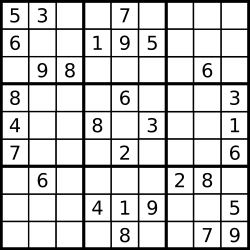
A partially filled sudoku which is valid.
Note:
A valid Sudoku board (partially filled) is not necessarily solvable. Only the filled cells need to be validated.

Solution: Helpe table
Declare 9 boolean array with length 9  separately for rows, columns and blocks and hold them in ArrayList. Because the number range of sudoku is 1-9, so each number in each row, col and block should be unique, then we can go through every position of given board, check if the number has been
Found in current row,current column  and current block. If so, return false;

*** Be careful about the index of block in blockChecker


Thursday, February 20, 2014

Path Sum II (Java)

Given a binary tree and a sum, find all root-to-leaf paths where each path's sum equals the given sum.
For example:
Given the below binary tree and sum = 22,
              5
             / \
            4   8
           /   / \
          11  13  4
         /  \    / \
        7    2  5   1
return
[
   [5,4,11,2],
   [5,8,4,5]
]

Solution:  DFS

Apply DFS check every possible combination, record result if meet requirement


Subsets (Java)

Leetcode

Given a set of distinct integers, S, return all possible subsets.
Note:
  • Elements in a subset must be in non-descending order.
  • The solution set must not contain duplicate subsets.
For example,
If S = [1,2,3], a solution is:
[
  [3],
  [1],
  [2],
  [1,2,3],
  [1,3],
  [2,3],
  [1,2],
  []
]

Solution: DFS

For  subset of a given set, it must contain a [],
So we can initialize a result with [[]] as start point.  For example, given set [1,2,3]
We can build the result from [[]]-> [[],[1]]->[[],[1],[2],[1,2]]->[[],[1],[2], [1,2], [3], [1,3], [2,3], [1, 2,3]]


Wednesday, February 19, 2014

Jump Game (Java)

Leetcode

Given an array of non-negative integers, you are initially positioned at the first index of the array.
Each element in the array represents your maximum jump length at that position.
Determine if you are able to reach the last index.
For example:
A = [2,3,1,1,4], return true.
A = [3,2,1,0,4], return false.


Tuesday, February 18, 2014

3Sum Closest (Java)

Given an array S of n integers, find three integers in S such that the sum is closest to a given number, target. Return the sum of the three integers. You may assume that each input would have exactly one solution.
    For example, given array S = {-1 2 1 -4}, and target = 1.


Monday, February 17, 2014

Convert Sorted List to Binary Search Tree (Java)

Given a singly linked list where elements are sorted in ascending order, convert it to a height 
balanced BST.

Solution:
Provide two solutions below.  One is relatively simple to come out which just convert the LinkedList to
 array then Convert the array to BST. But this solution may not be the one Interviewer wants.

The second one  performs the conversion in place, apply the feature of linked list  we can build the tree
from  bottom to up. Meanwhile use start and end two value to indicate the bounds


Saturday, February 8, 2014

Search for a Range (Java)

Leetcode

Given a sorted array of integers, find the starting and ending position of a given target value.
Your algorithm's runtime complexity must be in the order of O(log n).
If the target is not found in the array, return [-1, -1].
For example,
Given [5, 7, 7, 8, 8, 10] and target value 8,
return [3, 4].

Solution: because of O(logn), so we should consider about binary search, so how to apply binary search to find the low bound and high bound? We can make target -0.5 for searching low bound and target+0. 5 for the high bound. Be careful the corner case

Flatten Binary Tree to Linked List (Java)

Given a binary tree, flatten it to a linked list in-place.
For example,
Given
         1
        / \
       2   5
      / \   \
     3   4   6
The flattened tree should look like:
   1
    \
     2
      \
       3
        \
         4
          \
           5
            \
             6
Solution:
Divide and Conquer, convert left and right tree to list separately, then connect root. right to list converted by left tree, make root. left to null, then search for the lastNode of right tree and connect it to list converted by original right tree.

Count and Say (Java)

Leetcode

The count-and-say sequence is the sequence of integers beginning as follows:
1, 11, 21, 1211, 111221, ...
1 is read off as "one 1" or 11.
11 is read off as "two 1s" or 21.
21 is read off as "one 2, then one 1" or 1211.
Given an integer n, generate the nth sequence.
Note: The sequence of integers will be represented as a string.


Friday, February 7, 2014

Binary Tree Zigzag Level Order Traversal (Java)

LeetCode

Given a binary tree, return the zigzag level order traversal of its nodes' values. (ie, from left to right, then right to left for the next level and alternate between).
For example:
Given binary tree {3,9,20,#,#,15,7},
    3
   / \
  9  20
    /  \
   15   7
return its zigzag level order traversal as:
[
  [3],
  [20,9],
  [15,7]
]
confused what "{1,#,2,3}" means? > read more on how binary tree is serialized on OJ.


Combination Sum

LeetCode


Given a set of candidate numbers (C) and a target number (T), find all unique combinations in C where the candidate numbers sums to T.
The same repeated number may be chosen from C unlimited number of times.
Note:
  • All numbers (including target) will be positive integers.
  • Elements in a combination (a1, a2, … , ak) must be in non-descending order. (ie, a1 ≤ a2 ≤ … ≤ ak).
  • The solution set must not contain duplicate combinations.
For example, given candidate set 2,3,6,7 and target 7, 
A solution set is: 
[7] 
[2, 2, 3] 

Solution: DFS
calculate each possible combination

Partition List (Java)

Given a linked list and a value x, partition it such that all nodes less than x come before nodes greater than or equal to x.
You should preserve the original relative order of the nodes in each of the two partitions.
For example,
Given 1->4->3->2->5->2 and x = 3,
return 1->2->2->4->3->5.

Triangle (Java)


LeetCode

Given a triangle, find the minimum path sum from top to bottom. Each step you may move to adjacent numbers on the row below.
For example, given the following triangle
[
     [2],
    [3,4],
   [6,5,7],
  [4,1,8,3]
]
The minimum path sum from top to bottom is 11 (i.e., 2 + 3 + 5 + 1 = 11).
Note:
Bonus point if you are able to do this using only O(n) extra space, where n is the total number of rows in the triangle.
Solution: DP (met during Amazon interview)

Declare pathSum array with length of triangle size(). For triangle, the bottom row length is equal to the height of triangle, so use pathSum to hold the bottom row's value, then from bottom to up, find minimum path